

Bulgaria’s chronological backbone for the Neolithic, Copper Age, and the road into the Early Bronze Age
If prehistoric archaeology had a superpower, it would be this: the ability to turn broken pottery, burnt floors, and scattered bones into a sequence—a story with before, during, and after.
That’s exactly what the Karanovo System is: a relative chronological framework built from the stratified layers of Tell Karanovo in Upper Thrace, which became one of the key “timekeeping languages” for the Balkans.
It doesn’t just help date one site. It helps researchers (and readers) answer bigger questions:
- Which Neolithic phase are we in—early, middle, or late?
- How do Bulgarian sequences correlate with Vinča, Starčevo–Körös–Criș, or Lower Danube frameworks?
- Where does the Copper Age climax (KGK VI / Varna world) sit in time?
- And why do some transitions look messy, discontinuous, or debated?
Here we explain what the Karanovo System is, how it’s built, how it relates to neighboring frameworks, and where its limits lie, in a way that remains scientific, readable, and consistent.
Quick facts
- What it is: A relative chronology (phase sequence) derived from the stratigraphy of Tell Karanovo.
- Classic structure: Karanovo I–VII (seven major phases).
- How it’s used today: As a shared reference framework—flexible, revised, and cross-checked with absolute dating (radiocarbon, modeling, archaeomagnetism).
- Important correction: In standard scholarly usage, Karanovo I–IV belong to the Neolithic, Karanovo V–VI to the Copper Age (Chalcolithic), and Karanovo VII to the Early Bronze Age.
What exactly is “the Karanovo System”?
In everyday language, “Karanovo” can mean a place, a culture label, or a phase sequence. The Karanovo System refers to the phase sequence—a structured method for labeling layers in time.
Think of it like a periodization tool:
- A phase is a defined segment within a stratified sequence (a set of layers with consistent material traits).
- A system emerges when that phase sequence becomes widely used to correlate sites and regions.
So when you read “Karanovo III–IV” in a paper, it often means:
“This layer/assemblage looks like it belongs to the same time band and material tradition as Karanovo’s phases III–IV.”
This is highly useful in a region where many sites are not continuously stratified or where absolute dates remain uneven across subregions.
Where the system came from
The Karanovo System is rooted in the excavation history of Tell Karanovo and in Bulgarian efforts to develop a robust regional chronology based on stratigraphic evidence.
In the mid‑20th century, Georgi I. Georgiev synthesized stratigraphic work at Tell Karanovo into a formal chronological framework (commonly dated to 1961 in scholarship). This is why you’ll often see it referred to as the Karanovo Chronological System in academic writing.
From the beginning, the system relied heavily on:
- tell stratigraphy (layering over time), and
- ceramic typology (recurring pottery shapes, surfaces, firing, decoration), which is one of the most sensitive archaeological indicators of change.
Over time, the framework became a shared reference point not only for Bulgaria but also for broader Southeast European discussions—especially when synchronizing Bulgarian sequences with central Balkan and Lower Danube chronologies.
Why does it matter?
Prehistory has no written calendar. Without a framework like Karanovo, a pot or figurine is just “Neolithic-ish” or “Copper Age-ish.”
The Karanovo System gives you:
- Order (what comes before what)
- Comparability (how one region aligns with another)
- A common language (so researchers across borders can argue productively, not just talk past each other)
It’s also a perfect example of how archaeology actually works:
relative chronology first, then absolute dating to test, refine, and sometimes reshape the relative framework.
Karanovo I–VII at a glance
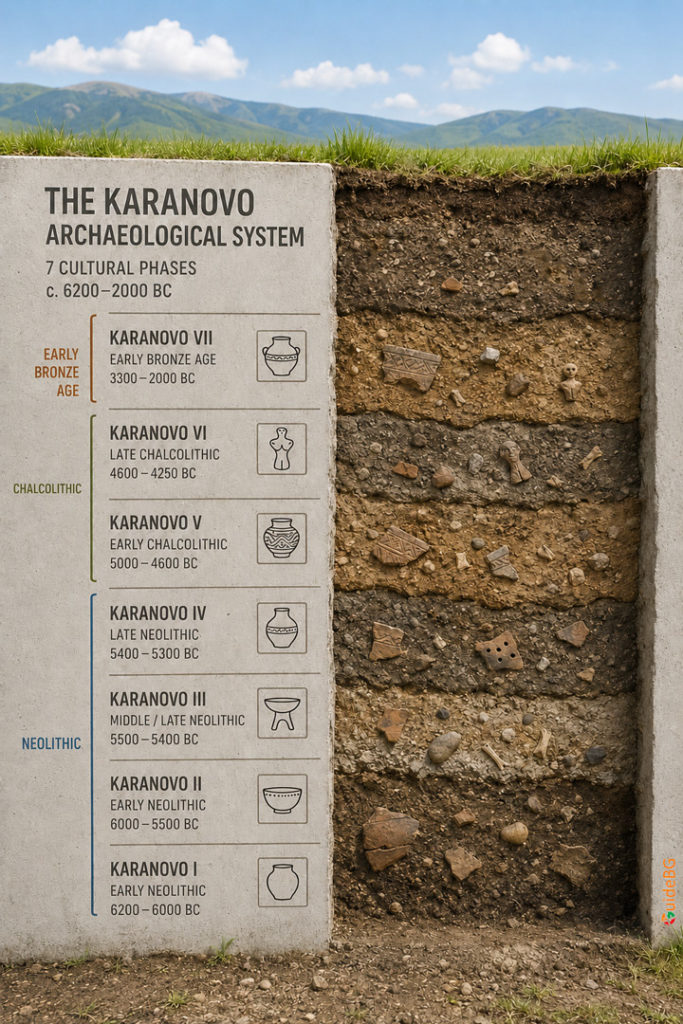
Phases, Ages, and how to interpret them
The phase-to-age mapping below is the standard way the system is understood in modern syntheses. Exact calendar ranges vary between publications and datasets, so treat the dates as orientation bands rather than fixed borders.
Karanovo I
Age: Early Neolithic
What it signals: Early farming village life; foundational pottery traditions for the Thracian plain.
Key correlations: Often discussed alongside the broader early farming horizon known as Starčevo–Körös–Criș.
Karanovo II
Age: Early Neolithic
What it signals: Continuity and development of early Neolithic lifeways; refinement in pottery and settlement rhythms.
Key correlations: Still within the early Neolithic horizon; regional variants become clearer.
Karanovo III
Age: Middle Neolithic / early Late Neolithic in some schemes
What it signals: A more consolidated Neolithic world with wider regional synchronisms.
Key correlations: Increasing comparative discussion with central Balkan frameworks, including the Vinča sphere.
Karanovo IV
Age: Late Neolithic
What it signals: Mature Neolithic dynamics; pottery styles and settlement patterns that are frequently used as synchronism anchors.
Key correlations: Strong overlap zone for discussions of Vinča-related synchronisms and broader Balkan ceramic transformations.
Karanovo V
Age: Copper Age (Early Chalcolithic) / transition band
What it signals: The shift into Chalcolithic lifeways; often linked in Bulgarian literature with the Maritsa (Marița/Marica) complex.
Key correlations: Early Copper Age developments across Thrace and neighboring regions.
Karanovo VI
Age: Copper Age (Late Chalcolithic)
What it signals: The Chalcolithic “climax” phase in many regional narratives—dense settlement networks and strong cross-border synchronisms.
Key correlations: Often treated as the Bulgarian-facing component of the broader Kodžadermen–Gumelnița–Karanovo VI (KGK VI) complex. This is the same larger world in which the Varna phenomenon sits chronologically.
Karanovo VII
Age: Early Bronze Age
What it signals: Early Bronze Age horizons in Thrace in the Karanovo system language.
Key correlations: Often discussed alongside Early Bronze Age sequences such as Ezero (especially in the context of the Chalcolithic → EBA transition).
Important scientific caution:
The system’s labels are not equivalent to seamless occupation at a single location. Tell Karanovo itself contains evidence for interruptions and complicated transitions—meaning “Karanovo VII” does not necessarily imply a smooth, uninterrupted evolution from “Karanovo VI” in every excavated area.
The Karanovo System is not a straight line
Interruptions, reoccupation, and why transition periods are hard
One of the biggest reasons prehistoric chronologies become controversial is that “endings” and “beginnings” rarely look neat in the ground.
Tell Karanovo is a case in point.
High-resolution radiocarbon work in published research has discussed a significant hiatus (gap) between the end of the Late Copper Age layer (associated with Karanovo VI) and the beginning of Early Bronze Age occupation (linked to Ezero A). In that study area of the tell, the end of Copper Age occupation was dated to the mid‑5th millennium calBC, while the earliest Early Bronze settlement appeared in the early 4th millennium calBC—suggesting a long interruption in that excavated zone.
This doesn’t mean “the region was empty.” It means:
- Settlement may have shifted elsewhere,
- The tell was not continuously occupied in all areas,
- Archaeological layers can be unevenly preserved and sampled.
Practical takeaway:
Use the Karanovo System as a chronological language, not as a promise of uninterrupted cultural continuity.
How archaeologists actually use the system
Relative chronology (Karanovo’s original power)
The Karanovo System began as a relative tool:
- Layer A comes before Layer B
- Pottery type X precedes pottery type Y
- Certain forms cluster consistently in one horizon and disappear in another
Relative chronology is essential because it works even when absolute dates are sparse or the sample material isn’t ideal for dating.
Absolute chronology (how the system gets refined)
Absolute dating—especially radiocarbon (AMS ¹⁴C)—adds calendar time, but it comes with its own methodological responsibilities:
- You need a good sampling strategy,
- Careful context control (avoiding intrusive material),
- Proper calibration to calendar years.
Modern practice often integrates multiple radiocarbon dates with stratigraphic constraints in Bayesian models, yielding tighter, more defensible time windows for specific phases and transitions.
Archaeomagnetism (a useful independent clock)
In some Balkan contexts, archaeomagnetic dating provides an additional independent tool (especially for burned features), helping test and anchor relative sequences and radiocarbon results.
Scientific best practice:
No single method “wins.” Robust chronology emerges when multiple lines of evidence converge.
Correlating Karanovo with the Balkans
Why “Vinča–Karanovo” exists at all
The Karanovo System is significant because it lies at the center of multiple regional synchronisms. Here’s a high-level way to read the correlations without turning them into a simplistic “culture equals people” narrative:
- Karanovo I–II ↔ Starčevo–Körös–Criș
(early farming horizon correlations) - Karanovo III–IV ↔ Vinča synchronism zone
(shared ceramic transformations, interaction spheres, and regional correlation debates) - Karanovo V ↔ Maritsa / Early Chalcolithic transitions
(Thracian-centered Copper Age emergence) - Karanovo VI ↔ KGK VI / Gumelnița–Kodžadermen–Karanovo VI complex
(Late Chalcolithic cross-border framework; Varna sits inside this wider world chronologically) - Karanovo VII ↔ Early Bronze Age horizons (incl. Ezero correlations)
(transition and reorganization period; local sequences vary)
Limits and common pitfalls
The Karanovo System is powerful, but it has limitations that serious archaeology openly acknowledges.
A type-site can’t represent an entire region perfectly
Karanovo is a single tell. Bulgaria is not a single tell.
Regional variation is real: different valleys, microclimates, and interaction corridors can produce different material rhythms—even within the same “phase label.”
“Phase” is not the same as “culture.”
Karanovo I–VII are primarily chronological labels, not guaranteed ethnic or linguistic units. Treat them as time-and-material packages, not as named people.
Transitions are the danger zone
Boundaries between phases are where:
- Mixed assemblages occur,
- Older material gets redeposited,
- Sampling problems appear,
- Interpretive bias is most likely.
Please check our separate explainers for:
Absolute dates can redraw the map
Radiocarbon programs can confirm traditional schemes or overturn them. That doesn’t “destroy” the Karanovo System; it upgrades it. In modern usage, the seven-phase nomenclature persists as a shared language, but its boundaries are treated more flexibly and continually refined.
How the Karanovo System is used in the context
Our editorial rules
- The Karanovo System is treated as a chronological framework
- Phases are mapped to Ages in the standard way:
- I–IV = Neolithic
- V–VI = Chalcolithic (Copper Age)
- VII = Early Bronze Age
- False precision is avoided, and the term “best-fit bands” is preferred when giving dates.
- Separated look into:
- Karanovo Culture = story + significance + lived world
- The Karanovo System = method + correlations + limits (this page)
- Vinča–Karanovo Interface = interaction-sphere label explained
- Karanovo VI is linked to the wider Late Chalcolithic world through KGK VI and to the Early Bronze Age discussion at Ezero.
Where to go next
If you want to “zoom in” after reading the framework, here’s the cleanest path:
- Karanovo Culture — the readable hub explaining the tell, the big story arc, and why Karanovo matters.
- Karanovo I: Early Neolithic beginnings (first farmers, early village life).
- Karanovo II: The early Neolithic deepens and stabilizes.
- Karanovo III: Consolidation and broader Balkan synchronisms.
- Karanovo IV: Mature late Neolithic dynamics and correlations.
- Karanovo V / Maritsa transition: The bridge into the Copper Age world.
- Karanovo VI & the KGK VI world: Late Chalcolithic climax and cross-border synchronisms.
- Varna and the Copper Age climax: Where Late Chalcolithic prestige economies become globally famous.
- Chronology of Archaeological Cultures in Bulgaria: The full prehistory timeline hub (Mesolithic → Neolithic → Chalcolithic → Transition → Early Bronze Age).
- Vinča–Karanovo Interface: the interaction model explained properly (influence, overlap, correlation—no “fusion culture” myth).
- Discrepancies in Archaeological Names and Discrepancies in Archaeological Cultures’ Timelines: The “decoder ring” for why terms and dates differ across sources.
Mini‑glossary
- Tell: a settlement mound built up by repeated rebuilding in the same place.
- Stratigraphy: the layered sequence of deposits at a site; the backbone of relative chronology.
- Typology/seriation: ordering material culture forms (like pottery) to infer sequence and change through time.
- Relative dating: placing things in order without calendar years.
- Absolute dating: assigning calendar ranges (e.g., via radiocarbon dating).
- Calibration (calBC): converting radiocarbon measurements into calendar-year ranges using calibration curves.